Program (specialized) accreditation
The CAAAE standards comply with the provisions of the Bologna Declaration and distinguish between first-cycle and second-cycle programs. The term «cycle» is used to define an educational program leading to the award of an academic degree. The first cycle includes bachelor’s degree programs, while the second cycle includes master’s degree programs.
Standards for specialized / program accreditation
The standards and criteria for specialized accreditation of higher education institutions have been developed in accordance with the Law of the Republic of Kazakhstan «On Education», the European Network for Accreditation of Engineering Education (ENAEE), the requirements of the Bologna Process, and international practice in specialized accreditation and auditing of higher education. The standards and criteria for specialized accreditation are intended for internal quality assurance of education at higher education institutions.
The European Network for Accreditation of Engineering Education (ENAEE) is a network of accreditation agencies whose goal is to create and ensure the functioning of a pan-European system for the accreditation of engineering educational programs.
The main objectives of the European Network for Accreditation of Engineering Education (ENAEE) are:
- Increasing confidence in the accreditation system for engineering programs;
- Promoting the EUR-ACE® quality label and its corresponding standards;
- Supporting, promoting and coordinating the work of national accreditation agencies, and initiating regular peer reviews.
The assessment and quality certification of accreditation agencies is carried out in accordance with the «Standards and Guidelines for Quality Assurance in the European Higher Education Area» (ESG) and the requirements of employers.
ENAEE members are agencies and professional organizations interested in the education and training of engineering specialists.
Accreditation agencies that are members of ENAEE have the right to award the EUR-ACE® quality label to accredited engineering educational programs of vocational and higher education.
Advantages of the awarded EUR-ACE® quality label:
- Inclusion of the program in the pan-European register of accredited engineering programs;
- Recognition of the high quality of the educational program at the pan-European level (above the required quality level established by legislation);
- Stimulating the inflow of promising applicants to the accredited program;
- Compliance of the knowledge, skills and abilities of graduates of accredited programs with European and international quality standards recognized by European employers;
- Provision of reliable information about the quality of the program and the competence of the graduate for admission of the graduate to the next level of education or to employment;
- Compliance of accredited programs with the educational requirements necessary for the registration/certification of an engineer.
At the moment, CAAAE is the only Kazakhstani accreditation agency in ENAEE, even though the number of national agencies that can be members of ENAEE is not limited.
ENAEE comprises 17 full members – accreditation agencies from the European Union (11 countries), Russia, Turkey and Switzerland, as well as 4 associate members.
The EUR-ACE® quality label has been awarded to more than 1600 engineering educational programs of 300 universities and other educational institutions in 21 countries around the world.
Procedure for specialized / program accreditation
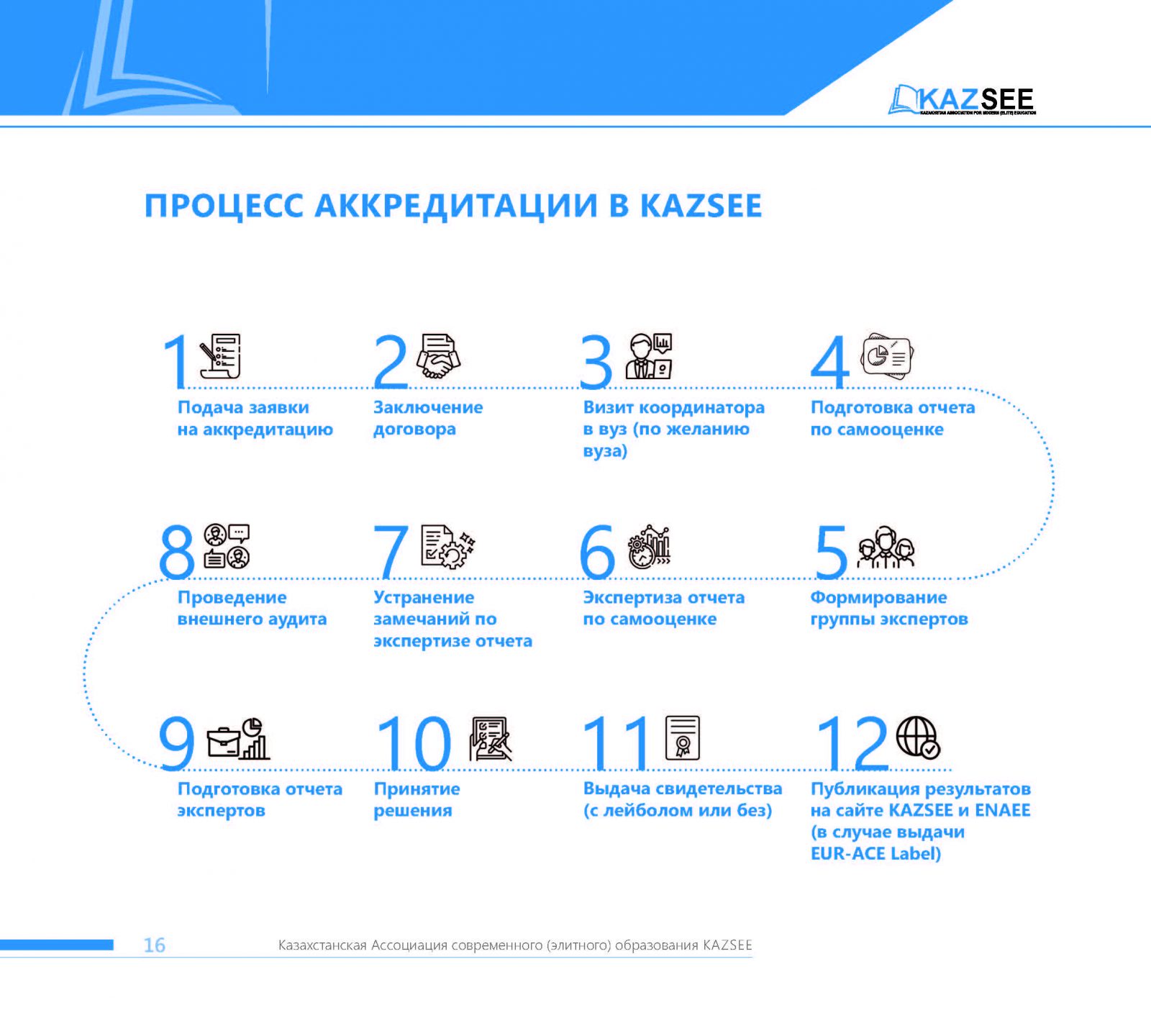
The specialized accreditation procedure has been developed by the agency in accordance with European and international standards and includes the following stages:
Stage I
- submission by the education organization of an application for accreditation to the agency with a brief description of the institution’s activities and copies of the general license and licenses for educational programs;
- signing of an accreditation agreement between CAAAE and the education organization. The agreement specifies the rights and obligations of the parties, the cost of the procedure, and the timeframe for the accreditation, including the levels to be covered;
- appointment of a coordinator, and a preliminary visit to the institution at its request if the agency is unfamiliar with it. Conducting seminars for the institution’s working groups on preparing the self-assessment report and carrying out the accreditation procedure;
- conduct of the self-assessment procedure by the educational institution and preparation of a self-assessment report in accordance with the CAAAE standards and criteria;
- submission of the first draft of the self-assessment report and its review by independent experts appointed by the relevant CAAAE accreditation committee. The results of the review are sent to the institution, and if necessary the self-assessment report is revised by the institution;
- submission of the final self-assessment report and its annexes to the agency.
Stage II
- CAAAE forms a competent group of experts, which includes representatives of educational institutions of Kazakhstan, an employer, a student and an international expert. The group is formed in parallel with the review of the self-assessment report;
- the agency informs the institution of the composition of the external audit group. If the institution suspects a conflict of interest involving any of the auditors, it has the right to apply to the agency for the replacement of the expert, attaching a written explanation;
- the coordinator sends the self-assessment materials and methodological support to the members of the expert group several weeks in advance to prepare for the external audit;
- the coordinator holds a preliminary webinar for the expert group in order to train the experts and discuss organizational issues of the audit, and a briefing before the start of the visit to the institution;
- the external audit at the institution lasts 3 days for institutional accreditation and 2 days for specialized accreditation. The external audit is carried out to assess the reliability of the information presented in the self-assessment report against the actual state of affairs in the education organization;
- the expert group prepares an external assessment report (indicating observations, recommendations for improvement, etc.), which is sent to the coordinator;
- the CAAAE coordinator sends the expert group’s report on the assessment of the institution’s activities to the education organization to correct any inaccuracies, if present.
Stage III
- based on the self-assessment report and the external audit report, the agency’s coordinator prepares a conclusion, which is agreed with the accreditation committee, and a presentation for the accreditation council;
- holding of a meeting of the CAAAE accreditation council and adoption of a decision on the accreditation of the institutional/specialized program. The accreditation council makes its decisions independently on the basis of the self-assessment report and the external audit report, the presentation and the conclusion;
- informing the institution and the members of the expert group that conducted the external audit of the accreditation decision taken;
- publication of the external audit report, the presentation and the accreditation results on the websites of CAAAE and ENAEE (in case of award of the EUR-ACE Label);
- sending information to the Ministry of Education and Science of the Republic of Kazakhstan for inclusion of the accredited institutional/specialized program in the corresponding National Register
Register of accredited educational programs
Reports
The register of accredited educational programs is also published on the Unified Higher Education Platform: epvo.kz.